
Over time, this section will grow into a collection of useful reference charts, guides, and tools for composers and orchestrators.
To get things started, the first release is a printable chart showing the practical and extended pitch ranges of the most popular orchestral instruments.
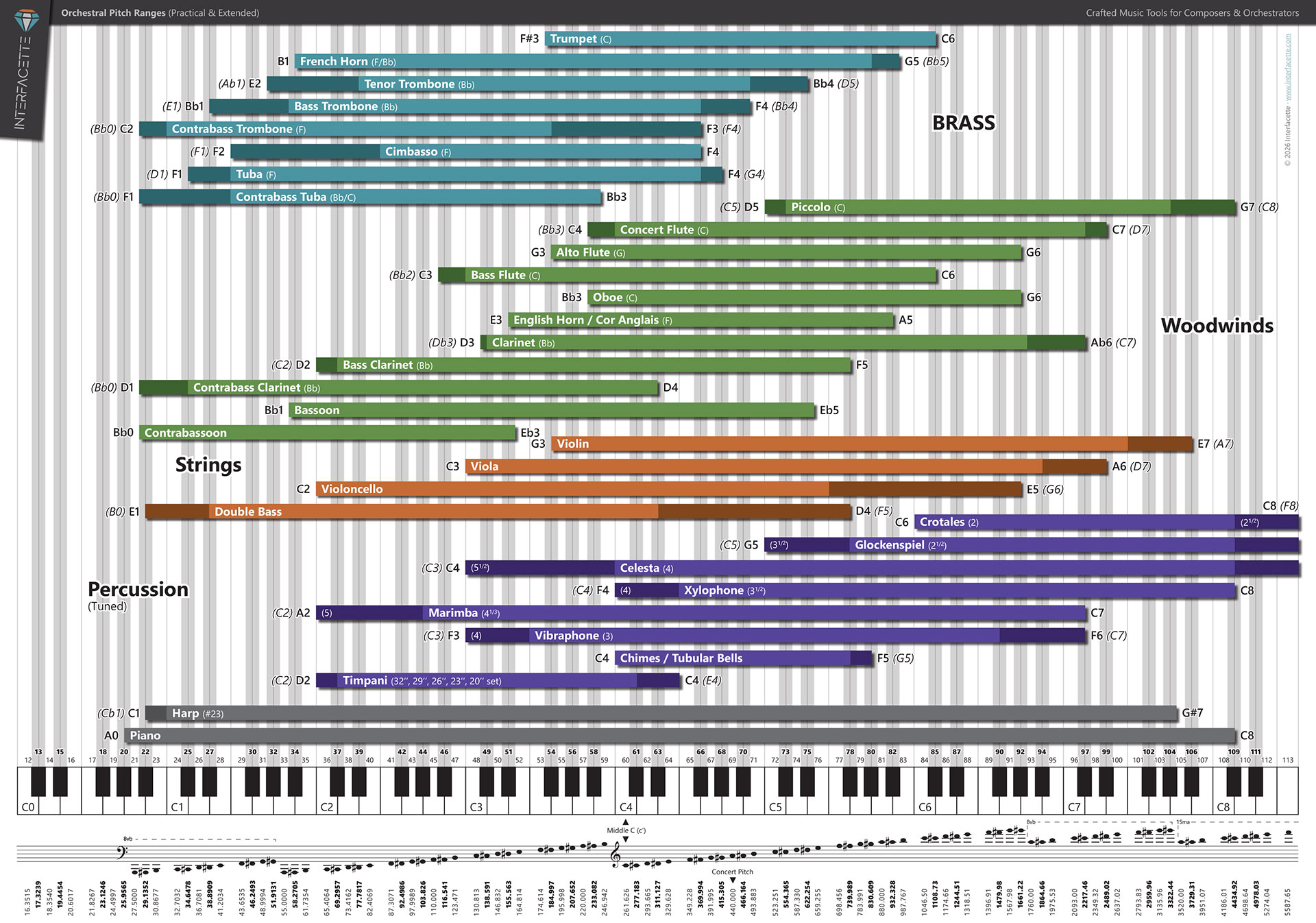
For the price of a coffee, get a handy reference chart for composers, orchestrators, and music students. Whether you are writing for violin, violoncello, flute, clarinet, French horn, or a full orchestra, the chart provides a quick overview of the practical and extended ranges of the most commonly used orchestral instruments. In addition, it includes concise notes on topics such as instrument extensions, pedal tones, intonation challenges in high positions, and special cases like harp retuning or low-B footjoints for the flute.
Brass:
Woodwinds:
Tuned Percussion:
Strings:
Plus:
Strings:
Intonation becomes increasingly demanding in the highest positions. While the notes shown in the extended range are playable, they are more commonly used by soloists than by orchestral sections, where a larger number of players must maintain accurate intonation. The instrument and fingerboard setup may also influence the highest available note. Many modern orchestral basses include a low C extension or a fifth string extending the range down to B0.
Concert Flute
A low B footjoint is common on professional instruments, extending the range down to B3. Notes above C7 are possible for advanced players but become increasingly demanding and produce a very bright, penetrating tone.
Trombones
Pedal tones are playable but can be difficult to produce cleanly, especially for amateur players. They require considerable breath support and skill, particularly when quick articulation is required.
Harp
The lowest string is not affected by the pedal mechanism. Its pitch must be set manually before the performance and cannot be changed during playing.


